It's about 11:30 pm (past our bedtime) but we're awake listening to the wind howl outside. After a lull this afternoon, the wind picked up again this evening. There have been some good gusts so far but nothing more severe than a typical stormy November day in Washington.
However, the same can't be said of our friends and teammates, the Farnums, who flew from Hanoi to Da Nang the other day to celebrate their wedding anniversary at a nice beachside resort. Da Nang happens to be directly in the path of the approaching storm--currently a Category 2 with winds around 100+ mph. They've been moved out of their cabin on the beach and put in a hotel about a football field's length away from the beach where they can watch the whole thing go down.
Also, the parents of Mo ("Muh"), a student that Joelle and I got to know last year, live right in the same area. Their house floods regularly as it is, and it looks like this one's going to be worse than normal. She sent Joelle a message this evening telling her that she's very worried for her family. (You can read about our visit to her family's house last year here.) Please keep Vietnam in general and especially the Farnums and Mo's family in your thoughts over the next few days here!
More updates as time, internet and electricity availability allow...
Monday, September 28, 2009

Sunday, September 27, 2009
Typhoon Ketsana
Well, the tropical storm which just dumped 13 inches of rain on Manila has beefed itself up to a Category 1 typhoon and is now bearing down on Vietnam's central coast. Currently it's still a ways out at sea but the winds have kicked up and the rain has definitely started.
 It's predicted to make landfall near Da Nang, about 200 miles north of us, with 70 to 90 mph winds and lots of rain. The effects here in Quy Nhon shouldn't be nearly as bad. For us, any troubles we experience will probably come from rainfall. It's kind of interesting (and a little scary) to watch the swells roll into the bay here, though. Quy Nhon itself is in a fairly well-protected little cove, but looking out across the bay you can see where the waves roll full-force into the rocks. Powerful stuff--and this is from a fairly weak system a couple hunred miles away.
I'll end with the requisite picture of a palm tree blowing in the wind, and a promise to keep you all updated if anything exciting should happen.
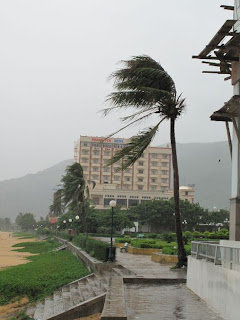
 It's predicted to make landfall near Da Nang, about 200 miles north of us, with 70 to 90 mph winds and lots of rain. The effects here in Quy Nhon shouldn't be nearly as bad. For us, any troubles we experience will probably come from rainfall. It's kind of interesting (and a little scary) to watch the swells roll into the bay here, though. Quy Nhon itself is in a fairly well-protected little cove, but looking out across the bay you can see where the waves roll full-force into the rocks. Powerful stuff--and this is from a fairly weak system a couple hunred miles away.
I'll end with the requisite picture of a palm tree blowing in the wind, and a promise to keep you all updated if anything exciting should happen.

Friday, September 18, 2009
Not quite summer camp
Time for a little snapshot of Vietnamese culture. A visit the other night from one of our friends—a fourth year student that Joelle got to know well last year—provided the insight and pictures for the entry you’re about to read.
One very big difference between Vietnamese college students and North American college students is how the two groups spend their summer vacations. Reaching back into the fog of my distant past, I can recall that an average North American college student might get a summer job, mooch off of mom and dad for a few months, work at a summer camp or perhaps go on a road trip with their friends. While Vietnamese students might take part in similar activities (with perhaps a bit more emphasis on the family side of things), every couple of summers they get to do something quite different from their American counterparts: military training.
Upon graduating from high school, Vietnamese have two choices: They can either continue on to some sort of post-secondary education or they can enlist in the military for two years. Not surprisingly, most of the students whose test scores are high enough choose to continue studying. But those students who do go on to higher education don’t get to fully escape the military. In a sort of accelerated “see what you missed” tour, each class of students has to attend a few weeks of training at least a couple summers out of their university careers.

While the words “military training” might conjure up images of crawling through mud under bands of concertina wire while drill sergeants shout obscenities at terrified trainees, we have been assured numerous times that military training is actually good fun. “We spent most of our time talking and playing cards,” one of the students assured us. “It was a good chance to get to know the other students in my department,” said another. In other words, it’s kind of like summer camp. Except instead of learning how to paddle a canoe or build a good campfire, students might instead learn how to disassemble and clean an AK-47 or successfully spot enemy aircraft at great distances. Merit badges are not awarded, unfortunately.
In the Vietnamese educational system, classes are formed the first year of university and remain the same throughout the four or five years that a student is in college. In keeping with this tradition, classes attend military training together as well. They sleep in the same barracks (at least two to a bed, no doubt), eat the same lousy food, and avoid the same outhouses. Though it might not do a whole lot to prepare them to repel invaders, it builds community and deepens friendships within the students’ classes and departments. And that’s not a bad thing.
From here on we’ll let the pictures—provided by our friend the 4th year student—tell the story.
 Military training lasts from a couple weeks to about a month. Students do morning exercises together, have a couple of instructional sessions and have a bit of homework they need to do each day, but for the most part they've got lots of free time.
 If you're observant, you might note that there are a lot of girls here. Boys and girls do train and study together, but this is the Foreign Language department which is about 95% female.
 This is Joelle's friend, showing off the sweet barracks where the students stay.
 The trainees have to buy their own uniforms. Some of them complained that the military-style pants were too big for them and thus were allowed to wear jeans.
 Judging by all of the pictures Joelle's friend showed us, posing for photos in front of the chalkboard was one of the more popular ways for students to pass time at military training.
 Students meet each day for "class" under a fig tree. Taking pictures with the figs was also quite popular.
 This was the base laundromat. Students wash their own clothes by hand (just as most of them do at home) and hang them up to dry outside. Groups of students stand guard in 1 hour shifts at night to keep anyone from coming and stealing their clothes hanging up outside.
 Getting ready to head back to Quy Nhon after an enjoyable couple weeks of training.
We hope you, too, enjoyed this brief glimpse of life for Vietnamese students!
Sunday, September 6, 2009
Ways to know you're back in Vietnam
Should you one day wake up to find yourself in the middle of a hot, humid country and you begin to wonder exactly where you are (Belize? Brazil? Bangladesh?) it may be useful to check the following telltale markers to determine whether you are, in fact, in Vietnam.
Marker 1: Whilst walking on the sidewalk, do you find yourself frequently having to avoid motorbikes that don't fit on the street? If so, you may be in Vietnam.

Marker 2: Are shower sandals provided in your hotel bathroom? Are said sandals much, much too small for your feet? If so, you may be in Vietnam.

Marker 3: Whilst standing in your hotel shower, does the showerhead point directly at your belly button? (See "A") At the same time, are you in immediate danger of giving yourself a concussion on the water heater? (See "B") If you answer "yes" to both of these, chances are quite good that you're in Vietnam.

Marker 4: Do you see people taking advantage of a road flooded by an overflowing lake to wash off their motorbikes? Further evidence that you may indeed be in Vietnam.

Marker 5: Are you astounded and humbled by the beauty of this place--the sky, the rice fields, the ponds, the people? Have you answered "yes" to each of these questions? Then yes, you can safely assume you've found yourself in Vietnam.


We're baaaaaack...
Marker 1: Whilst walking on the sidewalk, do you find yourself frequently having to avoid motorbikes that don't fit on the street? If so, you may be in Vietnam.

Marker 2: Are shower sandals provided in your hotel bathroom? Are said sandals much, much too small for your feet? If so, you may be in Vietnam.

Marker 3: Whilst standing in your hotel shower, does the showerhead point directly at your belly button? (See "A") At the same time, are you in immediate danger of giving yourself a concussion on the water heater? (See "B") If you answer "yes" to both of these, chances are quite good that you're in Vietnam.

Marker 4: Do you see people taking advantage of a road flooded by an overflowing lake to wash off their motorbikes? Further evidence that you may indeed be in Vietnam.

Marker 5: Are you astounded and humbled by the beauty of this place--the sky, the rice fields, the ponds, the people? Have you answered "yes" to each of these questions? Then yes, you can safely assume you've found yourself in Vietnam.


We're baaaaaack...
Monday, July 27, 2009
Some thoughts about train trestles
This entry was written a couple weeks ago while I had a lingering cold and thus had time to sit and ponder things a bit more than usual. I'm just finishing it up now...
Not feeling well but still needing to get out this morning, I took a walk in the 90 degree heat (a la Vietnam) up the road to Cedar Springs, a beautiful retreat center set at the edge of the Cascade foothills. It does the soul good just to stroll through there--stop by the pond, check out the flowers, and cool off in the shade of the giant cedars which give the place its name.
Today's walk also took me to an old railroad bed and out onto a trestle which spans a deep, forested gorge. Normally I'm in such a hurry to get somewhere that I walk across it without really thinking about it. Today, I stopped. And looked down. And felt a bit dizzy.
It really is a strange thing, being suspended a hundred-plus feet up in the air on a timber structure that was built over a century ago by people long dead and buried. To be clear: I'm not one of those weird railroad-obsessed guys who spend all their free time putting together model trains and watching documentaries about the specs of different sorts of steam engines. But when you stop and consider for a moment, you really do have to be impressed by the sheer engineering and logistical feat that is a train trestle. The fact that people using little more than some pulleys, maybe a steam donkey (whatever that is) and a lot of elbow grease could build something so massive and structurally sound is astounding.
One of the most impressive things about a trestle is the number of relatively small support beams that hold the whole thing together. I'm no engineer, but I would venture to say that, by itself, a single beam can't do a whole lot. I suppose you could toss it across a ditch and ride your bicycle over it if you were so inclined, but I wouldn't try driving a train (or a tricycle, for that matter) on it. Yet as the individual beams are bolted to the structure they become part of a system that, a hundred years down the road, still serves as a pretty dang good bridge.
I didn't linger too long on the trestle (lest someone see me and think I was a weird 'railroad guy') but as I walked home I was struck by how this was an object lesson for the work Joelle and I have been doing in Vietnam.
As I've supported cross-cultural workers in the past, I've sometimes wondered if my individual prayers to the Father or the small amount I'm able to give them each month really make much of a difference. Perhaps some of you have wondered the same thing as you support our work in Vietnam. From my vantage point now, I can answer that question with a resounding YES.
Just as a train would never have been able to cross that gorge at Cedar Springs without the support of those hundreds of individual beams, so Joelle and I would never be able to work and serve in Vietnam in our current capacity without the prayers and financial support of so many of you. Your petitions to the Father on our behalf and your sacrificial giving are not only appreciated--they're absolutely essential to the work that's being done.
As we prepare to return to Vietnam in just a few days now (August 19th!) we are very conscious of that, and thankful for the support we've received from all of you. Thanks!
Not feeling well but still needing to get out this morning, I took a walk in the 90 degree heat (a la Vietnam) up the road to Cedar Springs, a beautiful retreat center set at the edge of the Cascade foothills. It does the soul good just to stroll through there--stop by the pond, check out the flowers, and cool off in the shade of the giant cedars which give the place its name.
Today's walk also took me to an old railroad bed and out onto a trestle which spans a deep, forested gorge. Normally I'm in such a hurry to get somewhere that I walk across it without really thinking about it. Today, I stopped. And looked down. And felt a bit dizzy.
It really is a strange thing, being suspended a hundred-plus feet up in the air on a timber structure that was built over a century ago by people long dead and buried. To be clear: I'm not one of those weird railroad-obsessed guys who spend all their free time putting together model trains and watching documentaries about the specs of different sorts of steam engines. But when you stop and consider for a moment, you really do have to be impressed by the sheer engineering and logistical feat that is a train trestle. The fact that people using little more than some pulleys, maybe a steam donkey (whatever that is) and a lot of elbow grease could build something so massive and structurally sound is astounding.
One of the most impressive things about a trestle is the number of relatively small support beams that hold the whole thing together. I'm no engineer, but I would venture to say that, by itself, a single beam can't do a whole lot. I suppose you could toss it across a ditch and ride your bicycle over it if you were so inclined, but I wouldn't try driving a train (or a tricycle, for that matter) on it. Yet as the individual beams are bolted to the structure they become part of a system that, a hundred years down the road, still serves as a pretty dang good bridge.
I didn't linger too long on the trestle (lest someone see me and think I was a weird 'railroad guy') but as I walked home I was struck by how this was an object lesson for the work Joelle and I have been doing in Vietnam.
As I've supported cross-cultural workers in the past, I've sometimes wondered if my individual prayers to the Father or the small amount I'm able to give them each month really make much of a difference. Perhaps some of you have wondered the same thing as you support our work in Vietnam. From my vantage point now, I can answer that question with a resounding YES.
Just as a train would never have been able to cross that gorge at Cedar Springs without the support of those hundreds of individual beams, so Joelle and I would never be able to work and serve in Vietnam in our current capacity without the prayers and financial support of so many of you. Your petitions to the Father on our behalf and your sacrificial giving are not only appreciated--they're absolutely essential to the work that's being done.
As we prepare to return to Vietnam in just a few days now (August 19th!) we are very conscious of that, and thankful for the support we've received from all of you. Thanks!
Monday, July 20, 2009
Blogger, meet Facebook
Okay, so it's really a simple process and I don't know why I haven't done it before, but I just wanted to officially announce that new posts to our Vietnam blog (http://sjsvietnam.blogspot.com) will now appear--by means of some fantastic cyberwizardry--as new notes on Facebook. Hopefully that way some of my Facebook amigos will be able to better keep up with what we're doing in Vietnam, if they so choose.
That's about it for now. Yep.
That's about it for now. Yep.
Thursday, July 9, 2009
Video
In order to show folks what we've been up to for the past 15 months or so, we put together a short (5 minute) video with pictures and some interviews with students. It's focused mostly on the teaching aspect of our work over there, and though you're hopefully aware that our focus is broader than simply teaching English, we hope it gives a good glimpse of what we've been doing and what some of the students are like.
So, click and enjoy. Also, please note that there should be a new blog entry with more information about our summer directly below this entry, published just a short time before this one. Two entries in one day, you ask? Yes. That's what happened.
So, click and enjoy. Also, please note that there should be a new blog entry with more information about our summer directly below this entry, published just a short time before this one. Two entries in one day, you ask? Yes. That's what happened.
Subscribe to:
Posts (Atom)
